
Spatial Analysis
Hyperlocal geographic analysis of Internet performance
Overview
Understanding Internet performance requires analyzing data at fine geographic granularities. Our spatial analysis research develops methods for measuring, mapping, and modeling Internet performance variations across neighborhoods, census tracts, and even individual blocks.
Research Areas
Hyperlocal Performance Variability
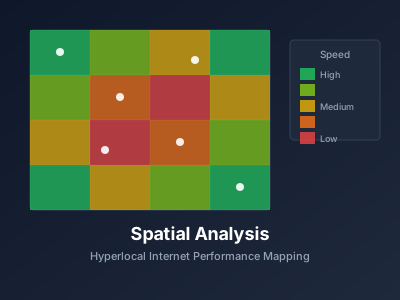
We study how Internet performance varies at hyperlocal scales—within neighborhoods and across small geographic areas. This research reveals that aggregate statistics often mask significant local disparities that affect residents’ actual experience.
IP Geolocation
Accurate geolocation of Internet measurements is critical for spatial analysis. We developed GPS-based methods for geolocating consumer IP addresses, enabling more precise mapping of Internet performance than traditional IP geolocation databases.
Spatial Sampling Methods
Effective broadband mapping requires careful attention to sampling methodology. We investigate how to design measurement studies that capture meaningful spatial variation while remaining feasible to deploy at scale.
Multi-Level Modeling
Internet performance is influenced by factors at multiple geographic scales—from individual households to neighborhoods to metropolitan regions. We apply multi-level statistical models to understand how these factors interact across scales.
Key Findings
- Internet performance can vary significantly even within small geographic areas
- Traditional IP geolocation methods introduce substantial errors in performance mapping
- Spatial sampling design critically affects the conclusions that can be drawn from measurement studies
Publications
A First Look at the Spatial and Temporal Variability of Internet Performance Data in Hyperlocal Geographies Taveesh Sharma, Jonatas Marques, Nick Feamster, Nicole Marwell TPRC, 2023
GPS-Based Geolocation of Consumer IP Addresses Jamie Saxon, Nick Feamster Passive and Active Measurement Conference (PAM), 2022
Collaborators
This research involves collaboration with researchers at the University of Chicago and USC, combining expertise in computer science, sociology, and urban policy.